

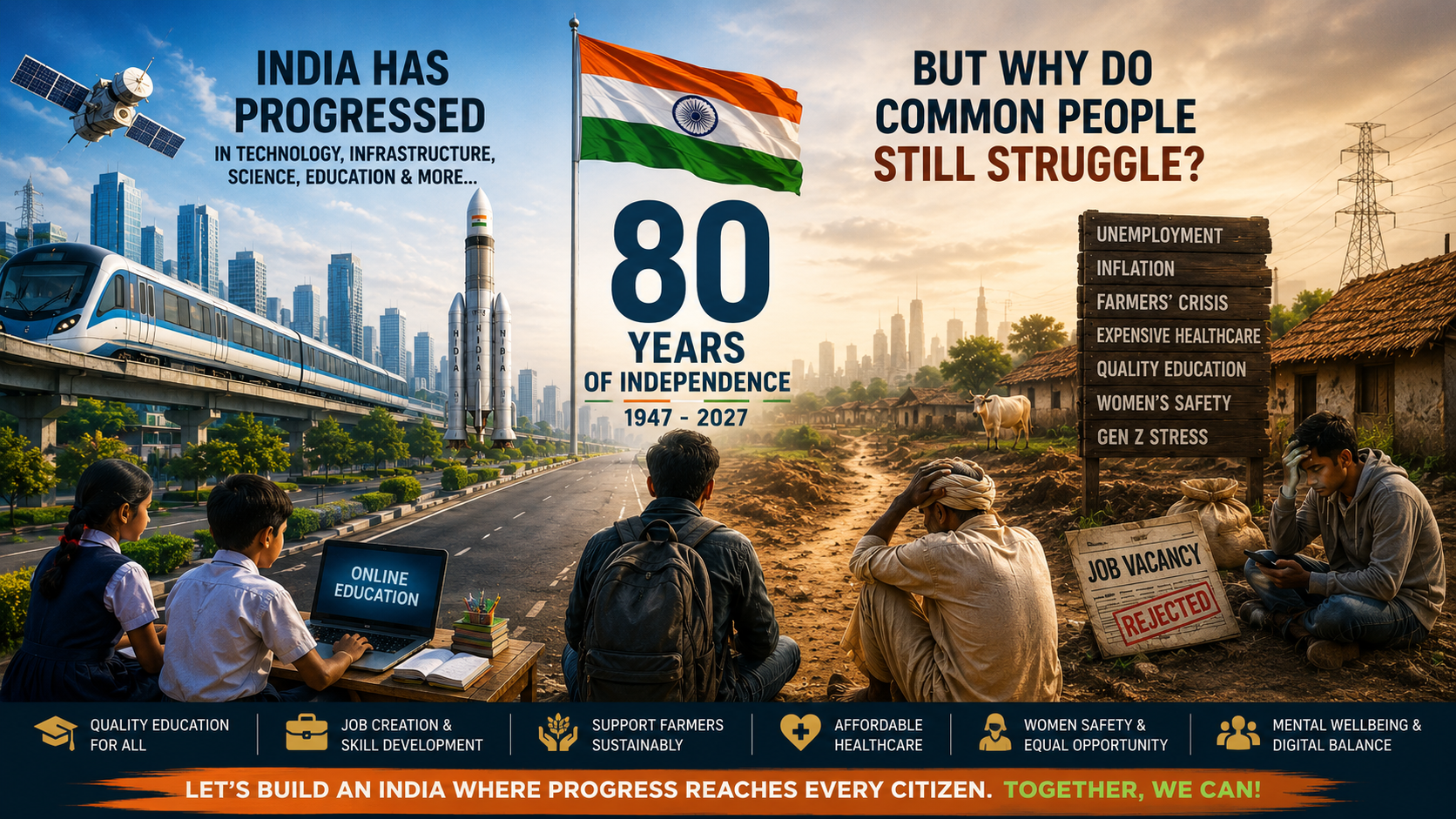
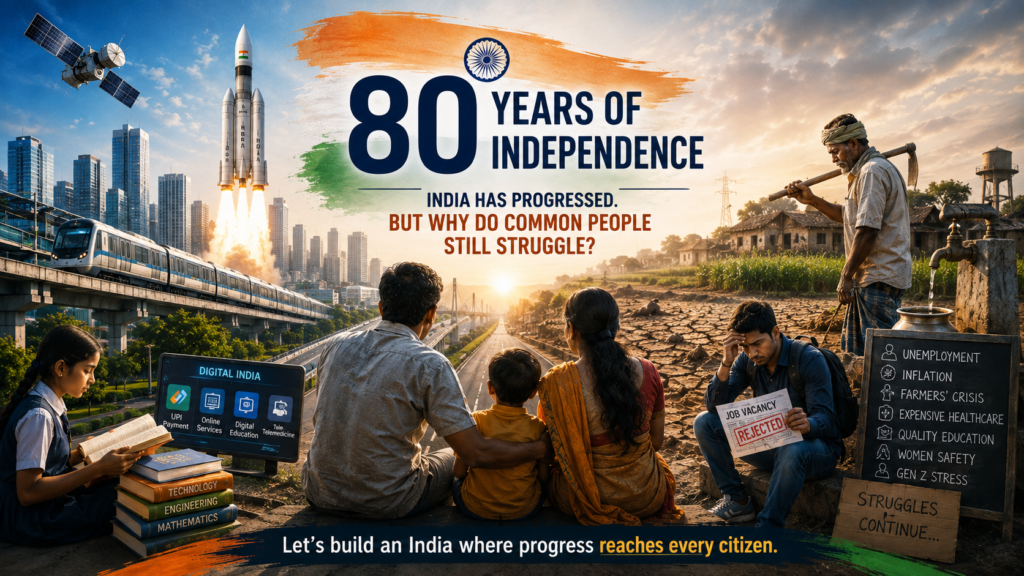
Independence : The problems of common people really changed? Explore unemployment, inflation, farmers’ struggles, healthcare, education, women’s safety and Gen Z challenges.
Every year, on 15th August, we proudly celebrate India’s Independence Day. We hoist the Tricolour, sing the national anthem, remember our freedom fighters and feel proud of how far India has come.
And yes, India has come a long way.https://www.ibef.org/economy/indian-economy-overview
Independence From a country struggling with poverty and limited resources, India has become a major global economy. We have sent missions to the Moon, built a strong digital payment system, developed world-class IT services, improved roads and infrastructure, and produced talented Indians who are working across the world.But on this Independence Day, perhaps we should ask ourselves one uncomfortable question:
After 80 years of independence, has the life of the common Indian become easier?
The answer is not simply yes or no.Independence
India has progressed. But at the same time, many ordinary people are still struggling with problems that affect their daily lives.
The farmer is worried about the price of his crop.
The middle-class family is worried about school fees and medical expenses.
The young graduate is worried about getting a job.
The small businessman is worried about rising costs.https://udtamaharashtra.com/
And today’s Gen Z is worried about something completely different—career uncertainty, social media pressure, AI and an increasingly competitive world.
So, while celebrating 80 years of freedom, it is also important to look at these realities.
We Got Political Freedom. But Do We Have Economic Freedom?
Our freedom fighters fought for India’s Independence political freedom.
Today, most Indians are not fighting a foreign government. They are fighting something else—financial pressure.
A middle-class family may have a decent income, but there are so many expenses waiting every month.
Rent or EMI.Independence
School fees.
Electricity bills.
Groceries.
Fuel.
Medical expenses.
Mobile and internet bills.Independence
And then, of course, some saving for the future.
Sometimes it feels like the salary comes into the bank account and leaves before we even realise it.
This is the reality for many families.Independence
Economic freedom should not simply mean having a job. It should mean having enough financial security to live with dignity.
A person should be able to face a medical emergency without selling everything they have.
A young couple should be able to plan for a home without spending their entire life paying EMIs.
A family should be able to educate its children without feeling that education itself has become a financial burden.
That is where the real meaning of economic freedom begins.Independence
Education Has Increased, But Is It Creating Opportunities?
There is no doubt that education in India has expanded tremendously.
Today, even a student from a small village can access online lectures, educational videos and study material from anywhere in the country.
This is a huge change.Independence
But there is still a gap between getting a degree and getting a decent job.
Every year, lakhs of young Indians complete graduation and post-graduation.
But then comes the question:
“Now what?”
Many students prepare for government exams for years because they want a stable job.
Others join private companies where they may have to work long hours for relatively modest salaries.
Some try freelancing or start small businesses.
The problem is not that Indian youth are unwilling to work.
In fact, our young people are ready to work hard.
The bigger problem is that the right opportunities are not always available at the right place and at the right time.
Our education system needs to focus more on practical skills.
Communication.
Technology.
AI.Independence
Financial literacy.
Digital marketing.
Entrepreneurship.
Vocational skills.
Problem-solving.
These are the skills that can help a young person earn, not just pass an examination.
The Farmer: Still Waiting for Stability
Whenever we talk about India, we talk about the farmer.Independence
We say, “The farmer is the backbone of the country.”
We hear this line every year.
But we should also ask:
Is the farmer able to live a financially secure life?
A farmer can work from early morning till evening.
He can spend money on seeds, fertilizers, pesticides, labour, electricity and transportation.
He can put months of hard work into one crop.
But after all this, he may still not know what price he will receive in the market.
If the crop fails, he suffers.Independence
If the crop is good but prices fall, he suffers again.
This uncertainty has to change.
The farmer needs more than temporary relief.
He needs better irrigation, storage facilities, modern technology, reliable market access, crop insurance, food processing facilities and better opportunities to add value to his produce.
Imagine if farmers could process and brand more of their own products instead of selling only raw agricultural produce.Independence
That could create a completely different rural economy.
Healthcare: One Illness Can Destroy Years of Savings
India has some excellent hospitals and highly skilled doctors.
Medical technology has improved tremendously.
But for an ordinary family, healthcare can still be expensive.
A serious illness can change the financial condition of an entire family.
A person may spend years saving money and then lose those savings because of one major medical emergency.
This is why healthcare should not be looked at only from the point of view of big hospitals.
We need stronger primary healthcare.
We need better health awareness.
We need preventive check-ups.
We need affordable medicines.Independence
And we need good healthcare facilities not only in big cities but also in villages and small towns.
A person should not have to travel hundreds of kilometres simply to get basic specialised treatment.
Inflation Is Not Just an Economic Number
When economists talk about inflation, they talk about percentages.
But ordinary people experience inflation differently.
A mother notices the grocery bill.
A student notices the increase in education costs.
A farmer notices the cost of fertilizers and diesel.
A worker notices the daily travel expenses.
A senior citizen notices the price of medicines.
For a rich family, a small increase may not make much difference.
But for a family with a limited income, every ₹100 matters.
That is why development should not be measured only by GDP.
We should also ask:Independence
How much money is actually left in an ordinary family’s pocket after paying for basic necessities?
Villages Are Changing, But Young People Are Still Leaving
Many Indian villages have changed dramatically.
Electricity has improved.
Roads have improved.
Mobile networks have reached remote areas.
Internet access has opened new possibilities.
Digital payments have become common.
But there is still one major problem.Independence
Where are the jobs?
A talented young person from a village may have to move to Nashik, Pune, Mumbai, Bengaluru or another city to find better opportunities.
This creates pressure on cities and slowly empties villages of their young population.
What if every district in India could create its own employment ecosystem?
For example, one district could focus on food processing.
Another could focus on tourism.
Another could develop textile businesses.
Another could build agricultural technology enterprises.
Another could become a hub for digital services.
This would create opportunities closer to home.
Government Services Have Become Digital, But Can They Become Simpler?
India’s digital transformation is genuinely impressive.
Today, many services can be accessed online.
Payments have become faster.
Documents can be downloaded digitally.
Banking has become easier.
Government schemes can reach citizens through digital systems.
But there is still a simple test of good governance:
Can an ordinary person complete the process without running from one office to another?
Technology should reduce confusion.
It should reduce paperwork.
It should reduce waiting.
It should reduce dependence on middlemen.
Simply putting a complicated form online does not automatically mean the system has become citizen-friendly.
The real goal should be simple government for ordinary people.
Women’s Freedom Must Be Felt in Daily Life
India has seen inspiring progress in women’s participation.
Women are becoming doctors, engineers, entrepreneurs, officers, scientists, athletes, teachers and business leaders.
But true freedom also means safety.
A woman should be able to travel alone.
She should be able to work late when necessary.
She should be able to start a business.
She should be able to make her own financial decisions.
She should be treated with dignity at home and at the workplace.
Women’s freedom should not exist only in speeches on Independence Day.
It should be visible in everyday life.
And Then There Is Gen Z
Now comes a generation with a completely different set of problems.
Today’s Gen Z has grown up with smartphones, YouTube, Instagram, online education, gaming and artificial intelligence.
They have access to opportunities that previous generations could not even imagine.
But there is a catch.
More choices do not always mean less stress.
Sometimes more choices create more confusion.
Should I take a government job?
Should I join a private company?
Should I start a business?
Should I become a content creator?
Should I learn AI?
Should I go abroad?
Should I prepare for an exam?
The young person is constantly asking:
“Am I making the right decision?”
Social Media Has Changed the Meaning of Success
Earlier, young people compared themselves with their friends.
Today, they compare themselves with thousands of people online.
Someone is travelling abroad.
Someone is buying a new car.
Someone is showing a luxury lifestyle.
Someone says they are earning ₹10 lakh a month.
Someone claims they became successful at the age of 22.
But we rarely see the failures behind those posts.
We don’t see the loans.
We don’t see the family support.
We don’t see the years of struggle.
We don’t see the failed businesses.
We only see the final picture.
This can make an ordinary young person feel like:
“Everyone is moving ahead except me.”
That is a dangerous mindset.
Success does not have one fixed age.
And life is not a competition with Instagram.
The Smartphone Is a Tool, Not Our Master
The smartphone is one of the greatest inventions of our time.
But honestly, how many of us pick up the phone for five minutes and end up scrolling for one hour?
One Reel becomes ten.
One YouTube Short becomes twenty.
Then suddenly we realise that half an hour has disappeared.
Technology is useful.
But we should not become prisoners of it.
For Gen Z, digital freedom should also mean having the ability to put the phone down.
AI Is Creating Excitement and Fear
Artificial Intelligence is opening new opportunities.
At the same time, it is making many young people nervous.
They wonder:
“Will AI take my job?”
The answer is more complicated than yes or no.
Some jobs will change.
Some tasks will be automated.
New jobs will emerge.
But one thing is becoming clear:
People who know how to work with technology will have an advantage over people who refuse to learn it.
So instead of fearing AI completely, young people should learn how to use it responsibly.
AI should become a tool that increases human productivity—not something that replaces human thinking completely.
Mental Pressure Is Real
There is another issue we cannot ignore.
Young people today face enormous expectations.
Get good marks.
Get a good job.
Earn a good salary.
Buy a house.
Support the family.
Get married.
Be successful.
And somehow, look happy on social media.
That is a lot of pressure for anyone.
We need to normalise conversations about stress, failure, career confusion and emotional well-being.
A young person saying, “I am struggling”, should not be treated as weak.
Sometimes they simply need someone to listen.
Financial Literacy Should Start in School
One major gap in our education system is financial education.
Many young people learn mathematics but do not learn how money actually works.
They should understand:
How to make a budget.
How to save.
How loans work.
What interest means.
Why insurance matters.
How investments work.
How taxes work.
How to avoid unnecessary debt.
Financial literacy can prevent many mistakes later in life.
If we want economically independent citizens, we should start teaching financial responsibility early.
What Should India Improve Before 2047?
India will celebrate 100 years of independence in 2047.
That gives us an important opportunity.
We should not only ask how big our economy will be.
We should ask what kind of life an ordinary Indian will have.
Here are some areas where India can focus more strongly.
1. Make education more practical
Students should learn skills that can help them earn, innovate and solve real-world problems.
2. Create jobs outside major cities
Smaller cities and villages should become centres of business, technology, tourism, manufacturing and services.
3. Strengthen small businesses
India’s small businesses are major employment generators. Easier access to finance, technology, training and markets can help them grow.
4. Make healthcare affordable
Preventive healthcare and strong primary health centres can reduce the financial burden on families.
5. Give farmers better market opportunities
Farmers should have better storage, processing, branding and direct market access.
6. Prepare youth for AI
AI education should become part of modern skill development.
7. Teach financial literacy
Saving, investing, insurance, taxation and responsible borrowing should become basic life skills.
8. Make government services simpler
A citizen should not need an expert to understand a government process.
9. Improve public transport and urban planning
As more Indians move to cities, affordable housing, public transport, clean surroundings and better planning will become increasingly important.
10. Measure development through people’s lives
GDP is important.
But so are happiness, health, employment, education, safety and financial stability.
We Should Not Be Afraid to Ask Questions
Talking about India’s problems does not mean we are against India.
In fact, the opposite can be true.
If we love our country, we should want it to become better.
We should celebrate our achievements.
But we should also ask difficult questions.
Why does a farmer still struggle?
Why does a graduate remain unemployed?
Why is quality healthcare expensive?
Why do women still worry about safety?
Why do young people feel so much career pressure?
Why does a middle-class family struggle despite earning a decent income?
These are not anti-national questions.
These are questions of a responsible citizen.
A strong India should be confident enough to hear criticism and use it to improve.
What Should India Look Like in 2047?
When India celebrates 100 years of independence, I hope we don’t only talk about being a large economy.
I hope we can say:
The farmer has a stable income.
The student receives quality education.
The young person gets meaningful employment.
The woman feels safe and financially independent.
The patient can afford treatment.
The senior citizen lives with dignity.
The small businessman gets a fair opportunity.
The young person is not afraid of AI but knows how to use it.
And the common family can save enough money to face tomorrow without fear.
That would be real development.
Conclusion: Independence Should Be Felt in Everyday Life
India’s 80-year journey is something we should be proud of.
We have achieved a lot.
But we still have a long way to go.
Independence should not be celebrated only by putting a flag on our profile picture or attending a school function once a year.
The real spirit of independence should be visible in everyday life.
It should mean economic freedom, quality education, affordable healthcare, meaningful employment, women’s safety, digital responsibility and equal opportunity.
Political freedom was the first step.
The next step is to make sure that the benefits of India’s progress reach the ordinary citizen.
Because at the end of the day, the real question is not:
“How much has India progressed?”
We already know the answer.
The real question is:
“How much better has the life of the common Indian become because of that progress?”
And as we move from 80 years of independence towards 100 years in 2047, perhaps this is the question we should all keep asking.
Because a truly developed India is not just a country with bigger buildings, faster internet and a larger economy.
It is a country where an ordinary person can look at the future and genuinely say—“My tomorrow will be better than my today.”
That, perhaps, is the real meaning of freedom.
Thông tin hữu ích quá. Letco tự hào là công ty tư vấn du học Hàn Quốc uy tín, cam kết đồng hành đến khi bạn nhập học thành công. Xem thêm tại letco.vn.
casinos en san jose
Here is my site; ruleta de casino juego de mesa
no wager no deposit bonus united states, fastest paying casino usa and poker run thousand islands 2021, or free no deposit bet rivers Casino nj uk 2021